


Business transformation consulting is rarely about a single technology investment or one ambitious strategic decision. For organizations operating in complex and fast-changing sectors, transformation requires a clear understanding of where the business stands, where it needs to go, and how that journey can be managed effectively. The right approach connects strategic objectives with practical execution, helping organizations move beyond plans and turn priorities into measurable improvements.
Why Business Transformation Consulting Needs More Than a Strategy
A well-written strategy provides direction, but direction alone does not create change. Organizations need a practical framework for translating strategic priorities into specific initiatives, responsibilities, timelines and measurable outcomes. This is where a transformation approach becomes important — it should answer several fundamental questions:
- What business challenge needs to be addressed?
- What outcomes should the transformation deliver?
- Which processes or capabilities need to change?
- What resources and technology will be required?
- How will progress and results be measured?
ETIAConsult’s experience in the energy sector reflects the importance of understanding operational realities before implementing solutions. Its work covers areas ranging from energy assets and transmission grids to trading desks, customer pricing and portfolio management — a breadth that allows transformation discussions to connect to the wider business environment rather than being considered in isolation. As McKinsey notes, the term “transformation” is often applied loosely to any form of change, however minor — a disciplined transformation strategy is what separates real change from a relabeled project.
Starting With Strategic Advisory
Successful business transformation consulting often begins with listening and assessment rather than immediate implementation. Strategic advisory provides an opportunity to understand the organization’s current operating model, identify areas of friction and establish priorities. This stage can reveal whether the main challenge lies in technology, process design, data quality, organizational structure or a combination of several factors.
For a business operating in the energy sector, these questions can be particularly important. Trading operations, risk management, settlements, compliance and reporting may depend on multiple systems and teams — a weakness in one area can therefore affect several others.
A structured assessment can help organizations distinguish between symptoms and underlying causes.
For example, recurring operational delays may appear to be a technology problem. A closer review may reveal duplicated processes, inconsistent data definitions or unclear ownership as the underlying causes — this diagnostic approach helps ensure that transformation investment is directed towards the issues that matter most.
Building a Practical transformation approach
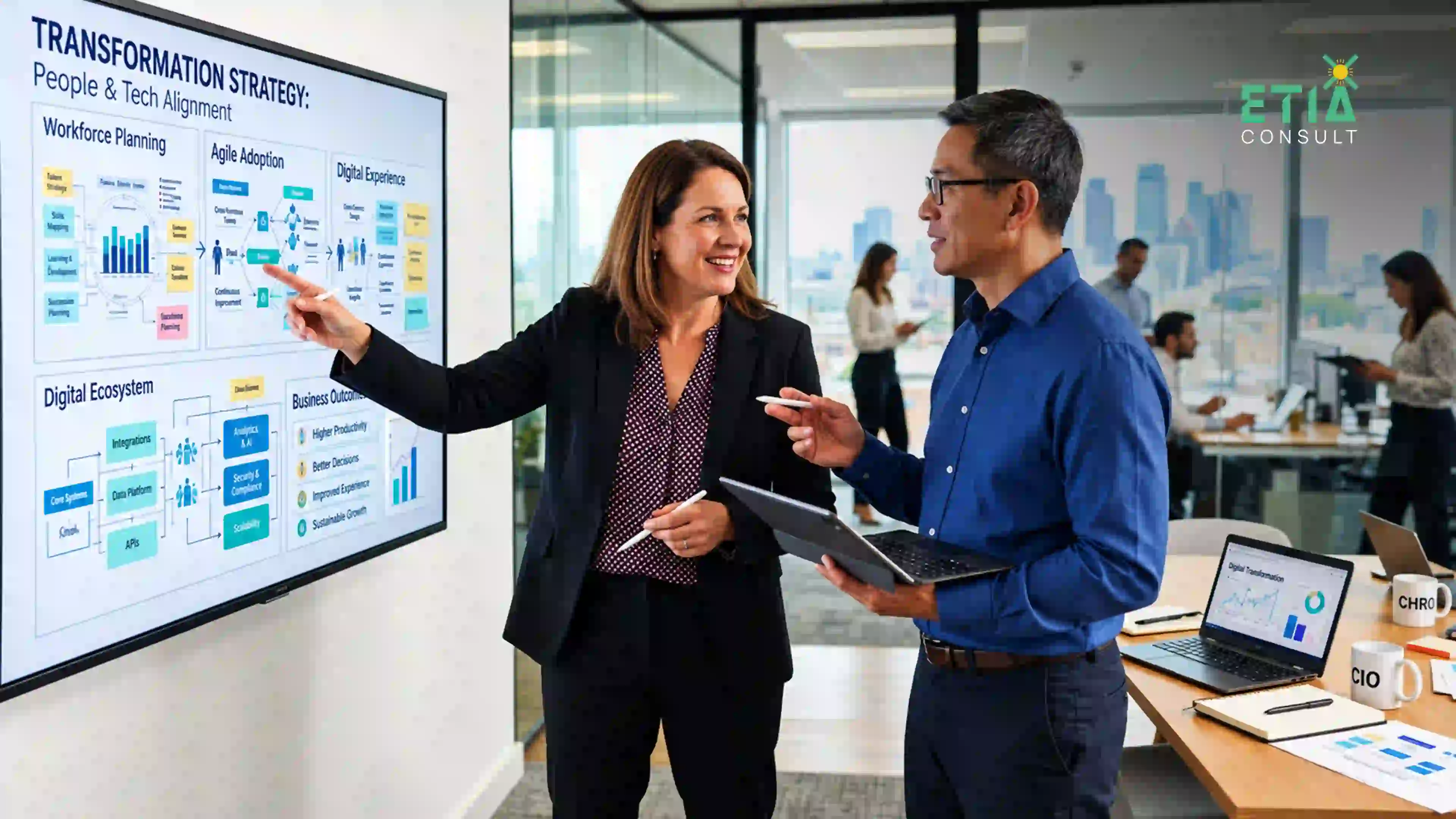
Once the current state is understood, effective business transformation consulting moves to the next step: defining a realistic transformation approach. The strategy should connect business objectives with specific areas of improvement. Rather than attempting to change everything simultaneously, organizations can prioritise initiatives according to their potential value, urgency and feasibility. A practical strategy may consider:
- Current business performance
- Process inefficiencies
- Technology capabilities
- Data maturity
- Regulatory requirements
- Organisational readiness
- Investment priorities
- Expected business outcomes
For ETIAConsult, this approach is particularly relevant to energy organizations dealing with increasingly complex operations. The company’s stated mission is to deliver agile IT and OT solutions that simplify complex challenges while supporting efficiency, sustainability, compliance and resilience — because transformation should ultimately improve how an organization operates, not simply introduce new terminology, platforms or processes.
Turning Strategy Into a Transformation Roadmap
Within business transformation consulting, a transformation roadmap bridges the gap between strategic ambition and practical delivery. It establishes what needs to happen, when it should happen and how different initiatives relate to one another. Without this connection, businesses can struggle with competing priorities or attempt too many changes at once. A useful transformation roadmap can divide a larger programme into manageable stages:
Assess & Prioritise
Assess the current operating model and identify priority improvement areas.
Define the Future State
Define the desired future state and select appropriate technology and process changes.
Establish Priorities
Establish implementation priorities across the wider transformation programme.
Measure Progress
Measure progress against agreed objectives and adjust as conditions change.
The roadmap should remain flexible enough to accommodate changing business conditions. A phased approach can provide greater control while allowing organizations to learn from each stage before moving forward.

The Importance of implementation strategy
In business transformation consulting, project delivery approach is where strategic ideas become operational activities. At this stage, organizations need clarity around responsibilities, dependencies, resources and timelines. It is also important to establish how teams will communicate throughout the programme — Harvard Business Review’s research on the strategy-execution gap found that leaders often focus on structures and processes when the real gap sits in how employees experience the change. implementation strategy can help answer practical questions such as:
- Who owns each transformation initiative?
- Which teams need to participate?
- What systems or processes will be affected?
- What risks could delay implementation?
- How will employees be supported through change?
- Which metrics will demonstrate progress?
ETIAConsult’s documented energy trading transformation began with a comprehensive process assessment before identifying automation opportunities and implementing an ETRM solution — incorporating data governance and cross-functional collaboration rather than treating technology as the only solution, as shown in our digital transformation case study for energy organizations.
Connecting Technology With Business Needs
Technology is an important enabler of modern business transformation consulting, but selecting a system before understanding the business problem can create unnecessary complexity. A technology solution should support a clearly defined business requirement — organizations therefore benefit from first understanding how processes currently operate and where improvement is needed. This is especially relevant when implementing enterprise platforms, automation solutions or energy trading systems.
In its energy trading case study, ETIAConsult describes an assessment-first approach in which process mapping preceded technology selection, supported by technology integration work once requirements were clear. This approach can help businesses avoid simply automating inefficient processes — technology should simplify workflows, improve visibility, strengthen data quality and support better decision-making, and its value becomes clearer when connected directly to measurable business outcomes.
Organizational Transformation and People
Technology and processes can change quickly, but sustainable business transformation consulting also depends on people. Organizational transformation involves helping employees understand why change is happening, what it means for their roles and how they can contribute to the desired outcome.
Employee Understanding
Employee involvement matters most when transformation affects established workflows employees know best.
Cross-Functional Collaboration
Collaboration across teams improves both the design and adoption of new processes.
Clearer Ownership
Involvement across roles helps ensure new processes reflect real operational requirements.
ETIAConsult’s energy trading case study highlights collaboration between traders, operations teams, risk professionals, finance personnel and technology specialists as part of the transformation process — the kind of involvement that creates clearer ownership across the organization.
Using Data to Support Better Decisions
Data is another essential element of business transformation consulting. Businesses may have access to large amounts of information but still struggle to use it effectively when data is fragmented across systems or departments. Inconsistent definitions, manual data entry and duplicate records can make decision-making slower and less reliable — so a transformation programme can include improvements to data governance, integration and accessibility.
In its documented energy trading example, ETIAConsult identifies data governance as a key component of the transformation process, including standardized data definitions, validation controls, ownership responsibilities and quality monitoring. Strong data foundations can support better reporting, operational visibility and risk management.
Measuring Transformation Outcomes
In business transformation consulting, transformation should not end when a new system goes live or a redesigned process is introduced. Organizations need to determine whether the changes are delivering the intended results. Measurement can include operational, financial and organizational indicators such as:
The appropriate measures will depend on the organization’s objectives. This focus on measurable outcomes also helps leadership understand whether transformation investment is creating practical value rather than simply completing project milestones.
A More Sustainable Approach to Business Change
Business transformation consulting is increasingly becoming an ongoing capability rather than a one-time project. Markets change, technologies evolve and customer expectations develop, so organizations need the ability to adapt continuously. For energy businesses, this need is particularly relevant because the sector is experiencing changes across technology, sustainability, regulation, trading and infrastructure.
ETIAConsult positions its work around agile and sustainable solutions for the energy sector, with experience across the energy value chain and a stated focus on reducing complexity, improving efficiency and supporting long-term resilience. This broader perspective allows transformation to be viewed as a continuous process of improvement rather than a single implementation exercise.
Why the Journey From Strategy to Execution Matters
The strongest transformation programmes connect every stage of the journey. Strategic advisory establishes direction. A transformation approach defines priorities. The transformation roadmap provides structure. execution strategy turns priorities into actions, while organizational transformation helps people adopt the changes. Technology and data then provide important tools for making those improvements sustainable.
Business transformation consulting can support this journey by bringing these elements together instead of treating them as separate projects — an approach ETIAConsult applies through strategic consulting, alongside related work on energy procurement strategy and energy flexibility. For organizations facing complex operational challenges, this integrated approach can make transformation easier to manage and more closely aligned with business objectives.
Conclusion
Business transformation is ultimately about turning ambition into practical and lasting improvement. A strategy may define where an organization wants to go, but successful execution determines whether it actually gets there. ETIAConsult’s approach demonstrates the value of connecting strategic thinking with operational understanding — its documented work in the energy sector places emphasis on assessment, process improvement, technology implementation, data governance and cross-functional collaboration.
For organizations considering transformation, the lesson is straightforward: technology should support the strategy, not replace it. Processes should be understood before they are automated, employees should be involved in organizational change, and progress should be measured against meaningful business outcomes. With a clear transformation approach, practical execution strategy and a well-defined transformation roadmap, businesses can approach complex change with greater structure and confidence.
Frequently Asked Questions
Key questions on business transformation consulting, strategy and execution
Turn Your Transformation
Strategy Into Results
ETIAConsult helps energy organizations in the Netherlands and across the EU move from strategic advisory to project delivery approach with a clear transformation roadmap.