



Sustainability reporting has evolved from a voluntary corporate initiative into a strategic business responsibility. Investors expect greater transparency, EU regulators continue to refine disclosure requirements under frameworks such as the CSRD, and customers increasingly evaluate organizations by their environmental, social, and governance commitments. As reporting obligations grow more detailed, businesses across the Netherlands and the wider EU face the same challenge: turning fragmented ESG data into accurate, meaningful, and compliant reports. Gen AI in sustainability reporting is beginning to reshape how organizations meet that challenge — not by replacing sustainability professionals, but by accelerating documentation, improving data organization, and supporting compliance.
Why Sustainability Reporting Has Become More Complex
Corporate sustainability reporting is no longer limited to publishing environmental achievements in an annual report. Organizations today are expected to provide measurable, verifiable, and consistent disclosures across a broad range of environmental, social, and governance indicators — increasingly benchmarked against the EU’s ESRS (European Sustainability Reporting Standards).
Reporting requires collaboration among multiple departments, each contributing information that makes data collection both extensive and challenging:
- Sustainability teams
- Finance
- Human resources
- Operations
- Procurement
- Risk management
The growing complexity of EU reporting frameworks has encouraged organizations to explore technologies that improve efficiency without compromising accuracy — a shift that is especially relevant as Dutch companies prepare for CSRD-aligned disclosure.
Understanding Gen AI in Sustainability Reporting
Generative AI refers to artificial intelligence systems capable of creating, organizing, summarizing, and interpreting information based on large datasets and user instructions. Within the ESG ecosystem, Gen AI in sustainability reporting supports professionals by streamlining numerous documentation and analytical tasks.
More Than Automated Writing
A common misconception is that generative AI simply writes reports. Its value extends much further, and human oversight remains essential throughout the reporting process:
Supporting Rather Than Replacing Experts
Generative AI enhances productivity by reducing repetitive work. Sustainability professionals continue making strategic judgments, validating data, interpreting results, and ensuring compliance with reporting standards. Technology accelerates the process — people remain responsible for the decisions.
Efficiency Without Sacrificing Quality
The greatest strength of AI lies in helping experts spend less time compiling information and more time evaluating sustainability performance — a distinction that matters as CSRD-aligned reporting cycles become increasingly demanding.
AI-Powered Sustainability Reporting Improves Workflow
Organizations managing large volumes of ESG information often struggle with fragmented documentation. This is where AI-powered sustainability reporting delivers measurable value across the reporting cycle.
Faster Report Preparation
AI generates initial content using validated datasets and predefined reporting structures, reducing preparation time while maintaining consistent formatting.
Improved Document Consistency
Generative AI helps maintain consistent language, structure, and formatting across sections drafted by multiple contributors.
Better Cross-Department Collaboration
When information flows more efficiently between teams, reporting becomes more coordinated and less dependent on lengthy manual consolidation.
Stakeholder-Ready Outputs
Teams can review, refine, and approve final reports faster — supporting the shorter internal timelines CSRD assurance requirements create.
Instead of manually drafting every section, AI can generate initial content using validated datasets, letting teams focus review time where it matters most: accuracy, materiality, and regulatory alignment.

ESG Compliance Automation Reduces Administrative Burden
Compliance has become one of the most demanding aspects of sustainability reporting. Regulatory expectations continue evolving — including the EU’s Omnibus simplification of the CSRD and ESRS — requiring organizations to demonstrate increasing levels of transparency and accountability even as rules are refined.
Simplifying Compliance Processes
ESG compliance automation supports organizations by helping organize documentation, monitor reporting requirements, and prepare information for review:
- Data consolidation across finance, operations, and sustainability functions
- Document version control across reporting cycles
- Compliance tracking against evolving CSRD and ESRS timelines
- Reporting schedules aligned to statutory and assurance deadlines
- Evidence organization to support external assurance review
Supporting Audit Readiness
Well-organized documentation simplifies internal reviews and external assurance processes. Automation also helps reduce duplication and improves traceability throughout the reporting lifecycle — a growing requirement as EU member states move toward mandatory sustainability assurance.
Compliance Is Becoming Continuous
Rather than preparing reports only once each year, organizations increasingly maintain ESG information throughout the reporting cycle. Automation supports this ongoing approach, keeping data audit-ready well before submission deadlines.
The EU’s Omnibus I Directive (in force from March 2026) has raised CSRD thresholds and simplified ESRS requirements, with member states — including the Netherlands — required to transpose the changes into national law by March 2027. Organizations should treat this as a shifting compliance landscape rather than a fixed target, and build reporting systems flexible enough to adapt as Dutch implementation legislation is finalized.
Generative AI for ESG Enhances Data Interpretation
Collecting sustainability information is only one part of effective reporting. Organizations must also understand what the data reveals. Generative AI for ESG assists by summarizing large datasets and identifying meaningful patterns.
Supporting Executive Communication
Senior leadership often requires concise summaries rather than lengthy technical reports. Generative AI can help prepare executive-level briefings that communicate key sustainability outcomes clearly and efficiently.
Better Decisions Begin With Better Information
Accessible insights encourage faster, more informed strategic discussions — enabling decision-makers to focus on strategic improvements rather than manual calculations alone.
Strengthening Sustainability Reporting Compliance
Meeting regulatory expectations requires more than producing attractive reports. Organizations must demonstrate that reported information is accurate, consistent, and supported by reliable evidence.
Improving Documentation Quality
Generative AI helps organize supporting information into logical structures, reducing inconsistencies that commonly arise during manual reporting — strengthening compliance by improving clarity and completeness.
Reducing Human Error
Although human review remains essential, AI can identify formatting inconsistencies, missing sections, duplicated information, and incomplete disclosures before reports reach final approval.
Accuracy Remains a Shared Responsibility
Technology supports quality; professional oversight ensures credibility. The strongest reporting combines both — particularly as third-party assurance becomes standard under CSRD.
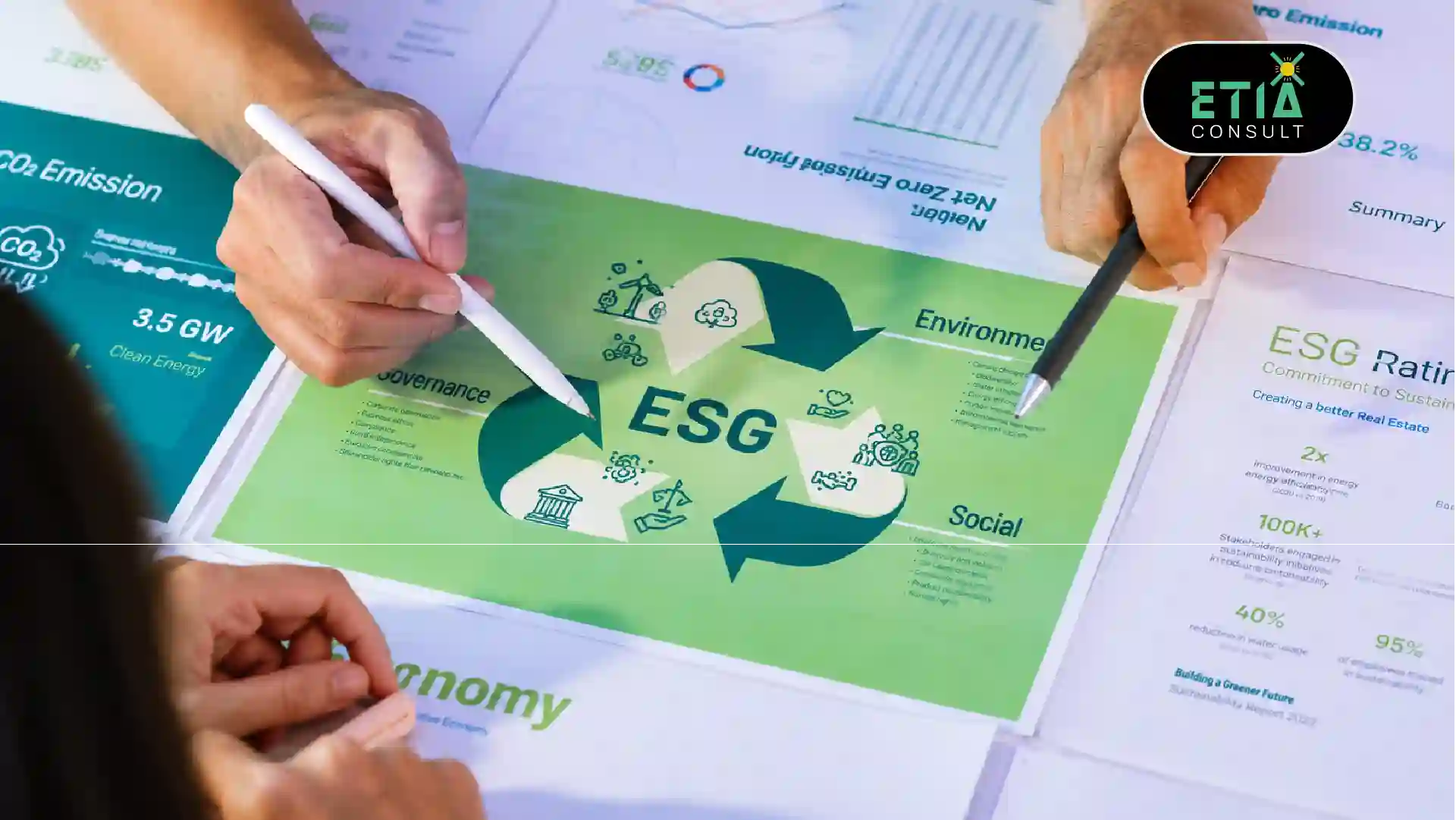
ESG Data Management: Building the Foundation
Every sustainability report depends on reliable information. Without trustworthy data, even sophisticated reporting tools cannot produce meaningful results.
Centralizing ESG Information
Effective ESG data management enables organizations to collect information from multiple business functions within a structured environment. Centralized systems improve:
- Data accessibility
- Version control
- Collaboration
- Reporting efficiency
- Long-term record keeping
Supporting Long-Term Strategy
Risk Assessment & Sustainability Planning
Well-managed ESG data extends beyond annual reporting, supporting proactive risk assessment and forward-looking sustainability planning.
Operational Improvements & Benchmarking
Reliable data supports performance benchmarking and highlights where operational improvements will have the greatest ESG impact.
Strategic Investment Decisions
Reliable information strengthens both compliance and business resilience — informing capital allocation toward sustainable growth.
Artificial intelligence performs best when supported by accurate, validated, and well-governed datasets. Strong governance remains essential — data quality determines report quality.
Challenges Organizations Should Consider
Despite its advantages, generative AI should be implemented thoughtfully. Successful implementation balances technological capability with human expertise and strong governance practices.
The Future of Sustainability Reporting
As sustainability expectations continue evolving, reporting processes will likely become increasingly intelligent, integrated, and data driven. Generative AI is expected to assist organizations not only with documentation but also with predictive analysis, scenario planning, and continuous monitoring.
However, technology alone will never define successful sustainability reporting. Trust, transparency, accountability, and informed leadership remain the true foundations of credible ESG performance. Artificial intelligence simply provides more effective tools to support those goals — and for organizations navigating the Netherlands’ evolving sustainable energy and CSRD landscape, that combination of technology and expertise matters more than ever.
Through strategic consulting and structured ESG data management, businesses that combine intelligent technology with strong governance, high-quality data, and expert oversight will be better positioned to deliver accurate disclosures and create lasting value.
Frequently Asked Questions
Key questions on Gen AI in sustainability reporting and ESG compliance
Turn Gen AI Into a Sustainability
Reporting Advantage
ETIAconsult helps organizations in the Netherlands and across the EU centralize ESG data, streamline CSRD-aligned disclosures, and apply Gen AI responsibly — with expert oversight at every step.