


Intelligent enterprise is the idea shaping how forward-thinking businesses now compete. Success depends on more than revenue, market share, or operational efficiency alone. Customers expect better experiences, employees need smarter tools, and organisations face growing pressure to use resources responsibly — all while artificial intelligence, automation, cloud computing, analytics, and connected systems continue changing how companies work. Adopting technology simply because it’s available doesn’t make an organisation intelligent. The real advantage comes from knowing where technology can solve meaningful problems and connecting those solutions to broader business objectives.
What Is an Intelligent Enterprise?
An intelligent enterprise uses technology and data to make business operations more informed, connected, and responsive. Rather than depending entirely on manual processes or isolated information, it creates an environment where systems can share data and support faster decision-making. It brings together people, data, technology, and processes to help organisations operate efficiently, respond to change, and build more sustainable ways of working.
- Analyse business performance
- Automate repetitive activities
- Forecast demand & market changes
- Improve customer experiences
- Monitor operational efficiency
- Identify potential risks
- Support employees with better information
The purpose isn’t to remove people from the equation. Technology should help employees spend less time on repetitive work and more time on activities that require judgement, creativity, communication, and strategic thinking.
The Growing Role of Enterprise AI
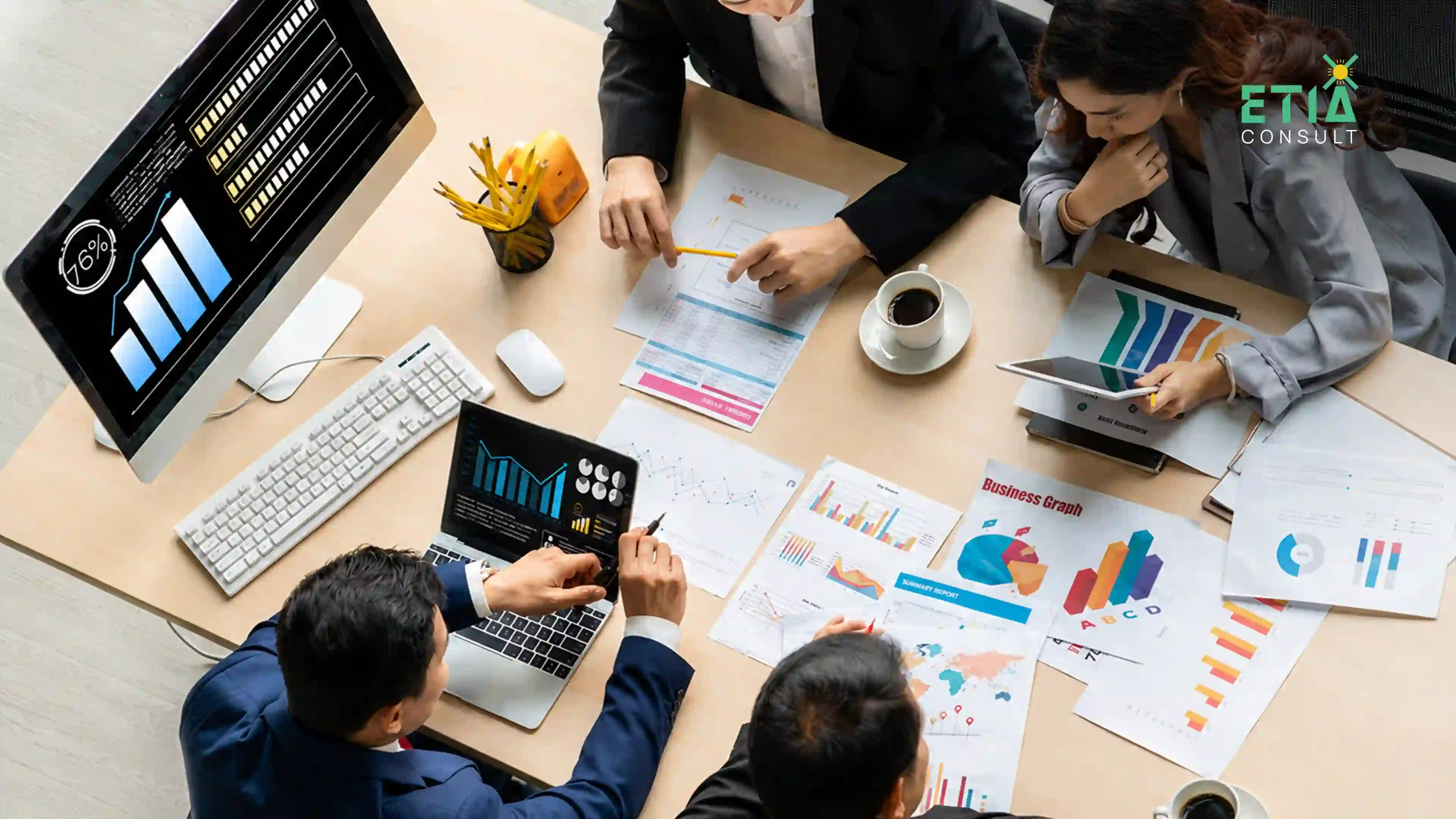
Enterprise AI is becoming an important part of modern business strategy. Artificial intelligence can process large volumes of information, recognise patterns, generate insights, and assist with decisions that would otherwise require considerable manual effort — for example, demand forecasting, customer service, fraud detection, predictive maintenance, document processing, and market analysis.
Successful AI implementation starts with a business need rather than a technology trend. AI can be powerful, but it’s only as useful as the information, processes, and people surrounding it.
Business Automation Makes Operations More Efficient
Employees often spend valuable time processing forms, updating records, generating routine reports, sending notifications, or moving information between systems. Business automation can reduce this administrative burden and create more consistent workflows.
- Invoice processing & employee onboarding
- Customer notifications & inventory management
- Routine reporting & approval workflows
- Data entry & reconciliation
The most effective approach is not to automate everything. Businesses should first examine how a process works and identify unnecessary steps — automating a poorly designed process may simply allow inefficiency to happen faster.
Digital Innovation Needs Direction
Digital innovation is often associated with emerging technologies, but innovation is ultimately about creating useful change. A new platform or application may look impressive, but its value depends on whether it improves something important.
A purposeful approach helps organisations avoid collecting technology without creating meaningful business value. Not every digital initiative will deliver the expected outcome, and that’s part of innovation — what matters is learning quickly, measuring honestly, and improving the next approach.
Sustainability Moves Into Everyday Operations
Sustainability is no longer limited to annual reports or corporate campaigns — it’s increasingly part of everyday operational planning. Businesses are examining how they consume energy, manage resources, transport products, operate facilities, and handle waste, and technology can make these activities easier to measure and optimise.
For sustainable operations to succeed, reliable data is particularly important. Without accurate information, organisations may struggle to identify where resources are being wasted or determine whether sustainability initiatives are actually producing results.
Where AI and Sustainability Meet
AI and sustainability can work together when technology is applied to practical environmental and operational challenges. If a company can estimate customer demand more accurately, it may avoid unnecessary production and excess inventory. Predictive maintenance can identify signs of equipment problems before a major failure occurs, potentially reducing downtime and unnecessary replacement, and AI can also analyse energy consumption to identify patterns that improve efficiency.
These examples demonstrate an important point: sustainability and efficiency don’t always have to compete. Reducing waste, improving asset utilisation, and optimising processes can support both environmental objectives and business performance — though organisations should also weigh the resources required to operate digital infrastructure and AI systems, since responsible technology adoption means looking at the complete picture.
People Still Matter
Discussions about automation and artificial intelligence can sometimes make the workplace sound like humans are about to become optional. In reality, intelligent businesses still depend heavily on people, who provide judgement, creativity, experience, empathy, and context that technology can support but not simply reproduce.
- Data literacy
- Digital tool proficiency
- AI awareness
- Cybersecurity practices
- Process improvement
- Critical thinking
When employees understand both the purpose and limitations of new technology, adoption becomes more practical and responsible.
Creating a Future-Ready Business
A future-ready business is not one that can predict every technological development — that would certainly make strategic planning easier, but nobody has been given that particular advantage. Instead, future readiness comes from adaptability.
Organisations can prepare by developing flexible technology infrastructure, reliable data systems, scalable processes, strong cybersecurity, continuous learning cultures, responsible AI governance, and measurable sustainability objectives — capabilities that let a business respond when customer expectations, regulations, markets, or technologies change without rebuilding its entire operating model.
Responsible AI Should Be Part of the Strategy
As AI becomes more deeply integrated into business processes, responsible use becomes increasingly important. Organisations need clear guidelines around privacy, security, transparency, bias, accountability, and human oversight — employees should understand when AI can be relied upon and when decisions require human review, particularly for systems that influence customers, employees, financial decisions, or other sensitive areas.
Trust is essential. Customers and employees are more likely to embrace technology when they understand how it’s being used and know appropriate safeguards are in place. For EU-based organisations, the European Commission’s regulatory framework for AI and the globally recognised OECD AI Principles both offer useful reference points for building this kind of governance.
Connecting Technology With Business Strategy
The greatest opportunity comes when AI, automation, and sustainability are treated as connected priorities rather than independent projects. Imagine a business using AI to forecast demand, automation to streamline procurement, and data analytics to monitor energy consumption — each capability contributing to a larger objective of operating more efficiently while using resources responsibly.
This integrated approach can support better decision-making, reduced operational waste, improved productivity, greater resource efficiency, faster responses to market changes, and stronger business resilience. Technology becomes more valuable when it works as part of a coordinated strategy — which is exactly what separates a genuinely intelligent business from one that has simply purchased a lot of software. ETIAconsult supports this work through technology integration and risk management services built around coordinated, responsible transformation.
Frequently Asked Questions
Common questions on AI, automation, and sustainability
Build a Smarter, More Adaptable
Business With ETIAconsult
ETIAconsult helps businesses in the Netherlands and across the EU connect AI, automation, and sustainability into one coordinated strategy.