



What IoT in Energy Management Actually Means
The Internet of Things refers to a network of physical devices equipped with sensors, software, and communication technologies that allow them to collect and exchange data. In the energy sector, these devices can be installed on machinery, electrical systems, renewable energy installations, and distribution infrastructure — creating a continuous stream of operational information that was previously unavailable without manual effort.
IoT in energy management specifically applies this connected device capability to understand how energy assets perform, how resources are consumed, and where operational issues are developing. Rather than depending entirely on scheduled inspections or delayed reports, operators gain access to equipment conditions as events occur — improving both the speed and quality of their operational responses.
The IEA’s energy digitalisation research identifies connected monitoring as one of the highest-value digital investments energy organisations can make — both for operational efficiency and for enabling the more flexible, responsive energy systems that the clean energy transition requires. This aligns directly with ETIAconsult’s technology integration advisory for energy businesses.
Real-Time Energy Asset Monitoring — How the Process Works
Energy asset monitoring through connected systems provides continuous access to operational information across equipment that may be spread across large geographic areas. Connected monitoring bridges the gap between where assets are located and where operational decisions are made — transmitting performance data to centralised dashboards that give operators a single coherent view of their infrastructure.
The energy asset monitoring process typically follows four sequential stages, each of which must function reliably for the overall system to deliver value:
Effective energy asset monitoring depends on much more than deploying sensors — it requires suitable sensor placement, reliable network connectivity, accurate and timely data feeds, clearly defined alert thresholds, and maintenance teams with the capacity and training to act on findings promptly. The value of monitoring is ultimately determined not by the sophistication of the technology but by the quality of the operational response it enables.
Real-time energy asset monitoring reduces the time between when a problem begins developing and when it becomes visible to an operator — creating the window for intervention that prevents minor issues from becoming major failures. The earlier the detection, the lower the remediation cost and operational impact.
Industrial IoT in Energy Operations
Industrial IoT applies connected device technology specifically to industrial operating environments — integrating equipment-level information with operational systems to provide a more comprehensive understanding of how assets perform under working conditions. In the energy sector, industrial IoT can be deployed across power plants, substations, refineries, manufacturing facilities, and renewable energy installations — anywhere where complex physical assets need continuous performance visibility.
The operational advantage of industrial IoT extends beyond individual asset monitoring. When different teams — maintenance personnel, plant managers, energy analysts, and operational planners — can access shared information from the same connected monitoring platform, their ability to coordinate effectively improves significantly. Rather than relying on disconnected reports that may reflect different time periods, different definitions, and different levels of detail, teams can work from a common operational picture and prioritise issues according to consistent criteria.
According to McKinsey’s operations research on industrial IoT, connected monitoring and predictive capabilities can reduce equipment downtime by 30–50% and cut maintenance costs by 10–25% in industrial settings — highlighting the scale of the operational opportunity that well-implemented IoT presents for energy organisations.
- Vibration sensors on rotating machinery detect unusual movement patterns indicating wear, imbalance, or misalignment before mechanical failure occurs
- Temperature monitoring on transformers identifies overheating that may indicate insulation deterioration or excessive load conditions requiring intervention
- Pressure sensors in pipeline systems reveal abnormal conditions that could indicate leaks, blockages, or developing equipment faults across distributed infrastructure
- Current and voltage monitoring flags electrical anomalies in generation, transmission, and distribution equipment before they cause supply disruption
- Smart meters on energy consumption enable detailed analysis of usage patterns across facilities, supporting both operational efficiency and the energy market analytics that inform procurement and trading decisions
Sensor Technology — The Foundation of Connected Energy Monitoring
Sensor technology converts physical conditions into measurable data that digital systems can process, transmit, and interpret. Selecting appropriate sensors for each application depends on the type of equipment, the operating environment, the parameters that matter most for that asset’s performance, and the data resolution required to detect the failure modes of concern.
Reliable sensor technology requires correct installation, appropriate calibration, and regular maintenance. Environmental factors — dust, moisture, extreme temperatures, and electromagnetic interference — can degrade sensor performance in the industrial operating conditions typical of energy infrastructure. Organisations must evaluate equipment compatibility and durability carefully before scaling monitoring networks across their asset base, and establish clear procedures for verifying that sensor readings remain accurate over time.
This connects to the broader data infrastructure considerations that ETIAconsult addresses in its sustainable digital transformation advisory — ensuring that the technology foundation supporting IoT monitoring is robust, secure, and aligned with the organisation’s operational requirements rather than selected based on vendor claims alone.
Predictive Maintenance — Moving From Reactive to Proactive
Predictive maintenance uses continuous equipment data to identify patterns associated with potential failures before they occur — enabling maintenance teams to intervene at a time of their choosing rather than responding to an unplanned breakdown. This shift from reactive to proactive maintenance is one of the most commercially significant applications of IoT in energy management, particularly for assets where unexpected failures are expensive, difficult to repair quickly, or create safety or supply reliability risks.
Conventional maintenance strategies operate either on fixed time schedules or in response to observed faults. Both approaches have limitations: scheduled maintenance may service assets that do not yet need attention while missing others that are developing problems between inspection windows; reactive maintenance responds only after a failure has already caused operational impact. Predictive maintenance offers a third path — using actual asset condition data to determine when attention is genuinely needed.
Fewer Unexpected Equipment Failures
Early warning detection from connected monitoring reduces the incidence of sudden failures that cause unplanned outages — particularly valuable for critical generation, transmission, and distribution assets where downtime has direct supply and revenue implications.
Better Maintenance Scheduling
Predictive maintenance enables teams to plan work at operationally suitable times — during planned outage windows, low-demand periods, or coordinated maintenance schedules — rather than responding to failures at the worst possible moment for operations.
More Effective Use of Technical Resources
Maintenance teams can prioritise assets that genuinely require attention rather than applying uniform intervention schedules to all equipment — reducing unnecessary maintenance spending while improving focus on assets where risk is actually elevated.
Extended Asset Service Life
Addressing deterioration earlier and under more controlled conditions can extend the useful operating life of eligible assets — improving return on capital investment and deferring replacement expenditure for equipment that can continue to operate safely and efficiently with appropriate maintenance.
The effectiveness of predictive maintenance depends on the quality of the underlying data — a monitoring system that generates frequent false alerts will erode operator confidence and reduce the responsiveness that makes the approach valuable. Clear alert threshold design, regular review of model performance, and experienced human judgement in interpreting findings are all essential to maintaining the credibility of the system over time. This is why ETIAconsult’s operational efficiency advisory treats predictive capability as an ongoing discipline rather than a one-time technology deployment.
Connected Energy Assets and Portfolio-Level Visibility
Connected energy assets — physical equipment equipped with sensors and communication technologies that enable them to share operational information — create the foundation for portfolio-level visibility that transforms how large energy organisations manage their infrastructure. Rather than viewing individual assets in isolation, organisations with properly connected infrastructure can compare performance information across multiple locations, time periods, and equipment types.
A utility operating multiple substations can compare transformer temperatures, load levels, and maintenance histories simultaneously. If one transformer consistently shows abnormal temperature readings under similar load conditions, the team can investigate the underlying cause across a shared platform rather than discovering the issue independently at each location. Connected energy assets also improve resource allocation — equipment showing early signs of deterioration can receive attention before conditions worsen, while assets operating within normal parameters can be maintained at a cadence appropriate to their actual condition rather than a universal fixed schedule.
This portfolio visibility is particularly valuable for distributed renewable energy systems, where generation assets may be spread across many locations. With appropriate connectivity and monitoring, organisations can maintain operational visibility across wind farms, solar installations, and battery storage facilities without the impractical cost of deploying field teams to each site for routine checks. The ENISA NIS2 critical infrastructure guidance also highlights connected asset monitoring as an important component of cybersecurity resilience for energy organisations — the visibility that IoT provides into asset behaviour is equally relevant to detecting unusual operational patterns that may indicate a security incident.
ETIAconsult’s advisory on cybersecurity for energy and utility companies specifically addresses the security controls that connected energy assets require — because every device added to an operational network is also a potential entry point that must be governed appropriately.

IoT in Renewable Energy — Managing Variable Generation
Renewable energy installations present specific monitoring challenges — and specific opportunities — for connected monitoring systems. Solar and wind assets often operate across wide geographic areas, depend on weather conditions that change continuously, and generate performance data that only becomes meaningful when interpreted alongside environmental context. This makes IoT in energy management particularly relevant for organisations with significant renewable portfolios.
Solar Installation Monitoring
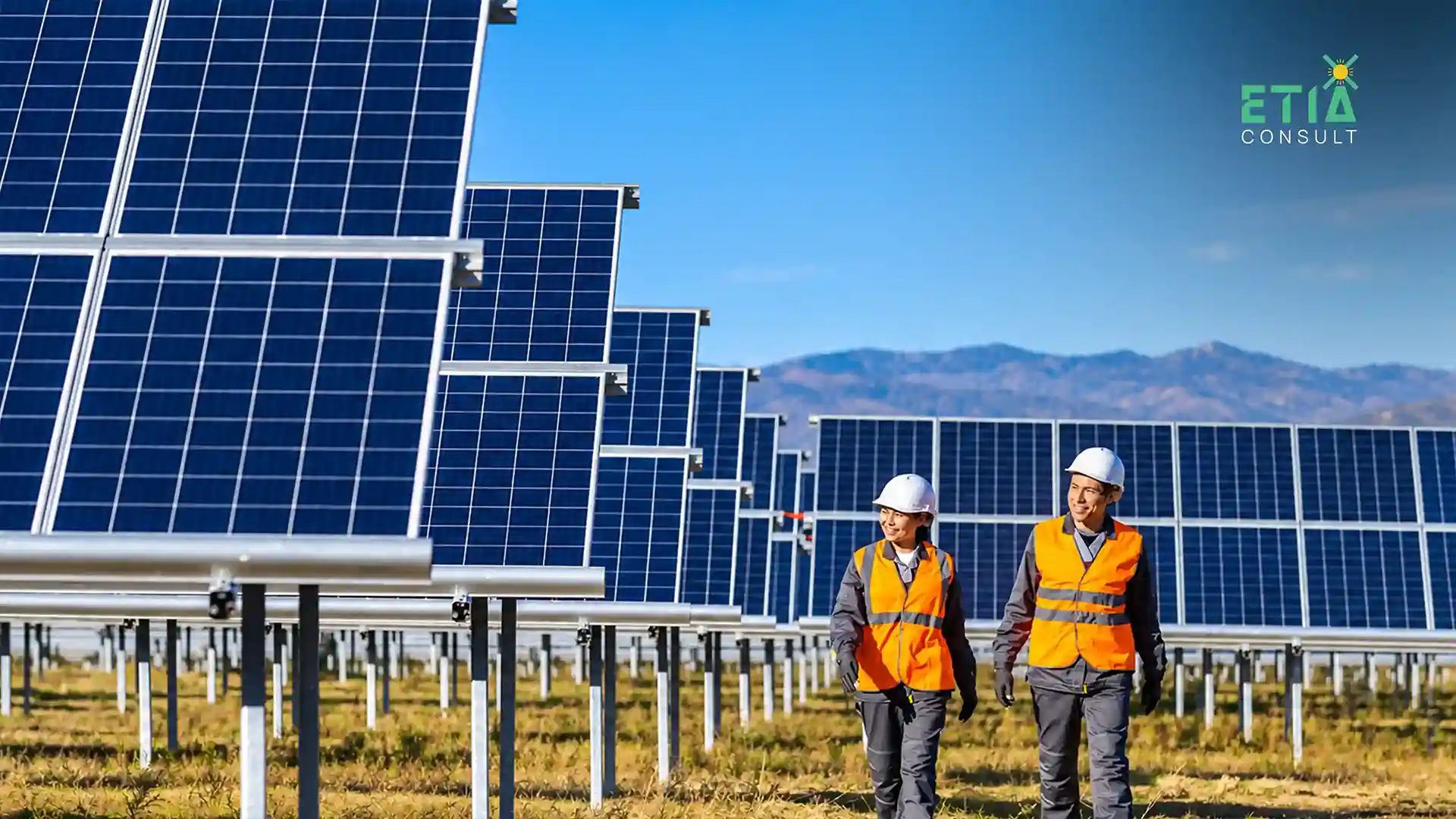
Connected sensors track power output, inverter performance, panel temperature, and module-level efficiency. When generation falls below expected levels, operators can investigate specific causes — equipment faults, shading, soiling, or inverter degradation — rather than identifying underperformance only in aggregated billing reports.
Wind Turbine Performance
Vibration, temperature, and operational data from turbine components help operators identify developing mechanical issues — reducing the unplanned downtime that can significantly affect annual energy generation and revenue from offshore or remote wind installations.
Battery Storage Management
Temperature, charge levels, state of health, and operational parameters from battery energy storage systems allow operators to maintain optimal operating conditions and identify degradation patterns before they affect storage capacity or safety.
Grid Integration Monitoring
IoT monitoring at the interface between renewable assets and the electricity grid helps operators detect power quality issues, manage export constraints, and coordinate asset dispatch with grid operator requirements — supporting the energy market forecasting decisions that optimise trading and dispatch across variable generation portfolios.
Challenges and the Future of IoT in Energy Operations
Despite its clear operational benefits, implementing IoT in energy management requires careful planning. Energy infrastructure may include older equipment that was not designed to communicate with modern digital platforms — integrating these legacy assets can require additional sensors, communication gateways, network upgrades, and software integration work. Connectivity is another significant consideration: remote substations, wind farms, and pipeline networks may operate in locations with limited or intermittent network coverage, requiring solutions specifically designed for challenging conditions.
- Legacy equipment integration — older assets without built-in connectivity requiring retrofit sensors, gateways, and protocol translation
- Cybersecurity requirements — every connected device adds a potential entry point requiring access controls, secure communication, and continuous security monitoring
- Data quality management — poor sensor calibration, false alerts, or inconsistent data standards undermine operator confidence and reduce the value of monitoring
- Skills and analytical capability — teams need the expertise to interpret monitoring outputs, verify alerts, and translate findings into appropriate operational responses
- Initial investment and phasing — sensors, connectivity, software, and integration require upfront capital that must be justified against measurable operational outcomes
The Future — AI, Digital Twins, and Deeper Intelligence
The most effective approach to IoT in energy management combines reliable technology with practical operational knowledge. Connected monitoring provides timely information, but trained professionals must interpret the results, verify potential problems, and make decisions that account for safety, cost, and service reliability. Technology amplifies expertise — it does not replace it.
Frequently Asked Questions
Key questions on IoT in energy management, energy asset monitoring, and industrial IoT
Ready to Build Smarter
Energy Asset Monitoring?
ETIAconsult helps European energy organisations design, evaluate, and deploy IoT in energy management — from connected energy asset strategies and industrial IoT architecture to sensor technology selection, predictive maintenance frameworks, and the cybersecurity controls that make connected monitoring safe to operate.