

Sustainable digital transformation is no longer simply about introducing new software, moving data to the cloud, or automating repetitive tasks. For organisations operating in a rapidly changing business environment, meaningful transformation requires a broader view — one where technology creates measurable value while supporting long-term business resilience, responsible resource use, and sustainable growth. ETIAconsult’s consulting framework reflects this wider perspective by placing purposeful innovation at the centre of digital change: not adopting technology for its own sake, but understanding why it is needed, how it supports organisational objectives, and how its benefits can be sustained long after the initial implementation.
Moving Beyond Technology Adoption in Sustainable transformation
Technology provides powerful capabilities, but technology alone does not create transformation. An organisation may invest in advanced platforms and still struggle to achieve meaningful results if its processes, people, and strategic priorities are not aligned with the intended change. This gap — between technology deployment and genuine organisational transformation — is where most digital initiatives fall short of their original ambitions.
A more effective Sustainable transformation journey begins with questions that shift focus from what technology to acquire to what business improvement to achieve. These questions form the foundation of ETIAconsult’s approach to strategic consulting for energy and enterprise organisations.
ETIAconsult’s starting questions move the conversation from technology acquisition to business improvement — and this distinction is critical:
- What business challenge needs to be addressed? — Anchoring digital investment in a genuine organisational problem rather than a technology trend
- Which processes create unnecessary complexity or resource consumption? — Identifying the operational friction that digital enablement can actually resolve
- Where can digital tools create measurable value? — Prioritising interventions by impact rather than novelty
- What capabilities will employees need? — Designing for adoption, not just installation
- How can innovation remain useful beyond the initial implementation? — Building for longevity rather than launch
Digital transformation for sustainability is ultimately about creating lasting organisational capability rather than completing a one-time technology project. The organisations that get the most from their digital investments are those that treat transformation as an ongoing operating discipline — not a project with a go-live date.
ETIAconsult’s Consulting Framework for Digital Innovation
A strong consulting framework provides direction without making innovation unnecessarily rigid. It helps organisations move logically from identifying an opportunity to implementing and evaluating a solution — creating a structured progression that reduces the risk of costly missteps while maintaining the flexibility needed to adapt to each organisation’s unique context, industry, size, and strategic goals.
ETIAconsult’s approach to agile consulting for businesses is built around this six-stage framework — practical enough to apply immediately, structured enough to ensure nothing critical is missed:
Understand
Deeply understand the organisation, its strategic priorities, operational context, existing technology, and the specific challenges that digital investment is intended to address.
Identify Opportunities
Identify specific opportunities for digital improvement — in customer experience, operations, data management, collaboration, or service delivery — ranked by potential impact and feasibility.
Evaluate Solutions
Evaluate potential solutions against business objectives, sustainability criteria, resource requirements, and long-term operational impact — not just technical capability or upfront cost.
Design Roadmap
Design a phased implementation roadmap that sequences high-value opportunities, manages disruption, and builds implementation confidence before tackling more complex transformation stages.
Enable Teams
Enable teams to adopt changes successfully — through training, communication, knowledge transfer, leadership involvement, and the cultural conditions that make new systems genuinely used rather than merely installed.
Measure & Refine
Measure outcomes against defined indicators and refine the approach continuously — treating implementation as the beginning of a learning cycle, not the end of the transformation journey.
This structure creates a logical progression that connects Strategic innovation with operational reality — allowing organisations to adapt the framework to their industry, scale, existing technology infrastructure, and long-term strategic priorities. It directly supports the digital transformation journey that ETIAconsult delivers for organisations across energy, utilities, and enterprise sectors.

Connecting Sustainable business strategy with Digital Innovation
Sustainability should not be treated as an additional requirement introduced at the end of a digital project — it belongs at the beginning of the decision-making process. A well-integrated Sustainable business strategy asks both sides of the innovation question: what positive impact can this technology create, and what resources will it consume? This balanced assessment helps businesses pursue Responsible digital transformation without losing sight of long-term responsibility.
According to the Global Reporting Initiative (GRI), organisations that embed sustainability into operational decision-making — including technology investment — consistently outperform peers on long-term value creation. This is the principle that ETIAconsult’s approach to sustainable finance and data-driven ESG strategy applies to digital innovation — treating sustainability not as a constraint on ambition, but as the quality standard that determines whether innovation creates genuine long-term value.
Positive Digital Impact
Digital systems that help organisations improve resource planning, reduce unnecessary processes, monitor operational performance, and make better-informed decisions — creating value while aligning with the sustainability reporting requirements that regulators increasingly mandate under CSRD.
Resource and Environmental Considerations
Digital technology has its own environmental footprint — energy consumption, hardware requirements, data storage, and system complexity. A responsible Sustainability framework evaluates these costs alongside benefits rather than treating technology as inherently neutral.
Long-Term Value Creation
Innovations assessed against long-term consequences — economic, environmental, operational, and social — rather than short-term cost or feature metrics. This extended evaluation horizon is what distinguishes Responsible digital transformation from conventional IT project management.
ESG Framework Alignment
Connecting digital investment decisions to ESG frameworks and Corporate Sustainability 2.0 commitments — ensuring digital transformation reinforces rather than contradicts organisational sustainability obligations to investors, regulators, and stakeholders.
The Role of Innovation Consulting in Purposeful Digital Change
Strategic innovation helps organisations move from broad digital ambitions to practical, prioritised action. Businesses often know that they need to innovate but may not know where to begin, which opportunities deserve investment, or how to build the internal capability to sustain the changes they implement. This is where structured innovation consulting creates disproportionate value — converting strategic intent into operational reality.
ETIAconsult’s Strategic innovation approach identifies areas where digital intervention could have the greatest impact. These may include customer experience, internal operations, data management, workforce collaboration, supply chains, or service delivery — assessed not by which technology is most impressive, but by which intervention creates the most measurable organisational improvement. This is the distinction between purposeful enterprise innovation and innovation for innovation’s sake.
Innovation should have a clear purpose and a connection to measurable organisational outcomes — not simply introduce technology because it is new or because a competitor has adopted it. The organisations that benefit most from Innovation strategy are those that bring discipline to opportunity selection, not just enthusiasm for what is technically possible.
Where Innovation strategy Creates the Most Value
Creating a Digital Enablement Roadmap That Works
Once priorities have been identified, organisations need a realistic path from strategy to implementation. Digital enablement involves creating the conditions that allow people, processes, and technology to work together effectively — going beyond platform selection and installation to address the full organisational context in which technology must operate. This is the work that determines whether a technically successful implementation becomes a commercially successful transformation.
ETIAconsult’s digital enablement roadmaps account for the full implementation context — a methodology detailed in the technology integration for enterprises advisory and future-ready business framework ETIAconsult has applied across European organisations.
Existing Technology and Infrastructure
Assessing current systems, integration points, and technical debt before designing new solutions — ensuring that innovation builds on a foundation that can support it rather than requiring costly parallel infrastructure to function.
Skills and Workforce Readiness
Evaluating current digital capability across the organisation — identifying training needs, change readiness, and the communication investment required to move employees from awareness to confident adoption of new systems and processes.
Security, Governance, and Data Quality
Embedding security and governance requirements from the design stage — and assessing data quality and availability to ensure that analytics, AI, and automation tools have the reliable data foundation they require to deliver their stated benefits.
Phased Implementation for Managed Progress
A phased roadmap reduces disruption by beginning with high-value, lower-complexity opportunities — building implementation confidence, capturing early wins, and generating learning that informs later, more complex transformation stages. This creates sustainable momentum rather than attempting to transform everything simultaneously.
Supporting Enterprise Innovation as an Organisational Capability
Enterprise innovation requires more than isolated ideas from a single department. For Responsible digital transformation to have lasting impact, innovation needs to become part of the organisation’s broader operating culture — embedded in how teams identify problems, propose solutions, and share learning across functional boundaries. This cultural dimension is what separates organisations that transform once from those that continuously improve.
According to McKinsey Digital research, organisations where innovation is embedded in operating culture — rather than confined to dedicated innovation labs — generate 2–3 times the return from digital investment over five-year periods. This cultural integration is the objective of ETIAconsult’s enterprise innovation advisory, connecting individual digital projects into a continuous organisational learning and improvement capability.
Measuring What Matters — and Building Internal Capabilities
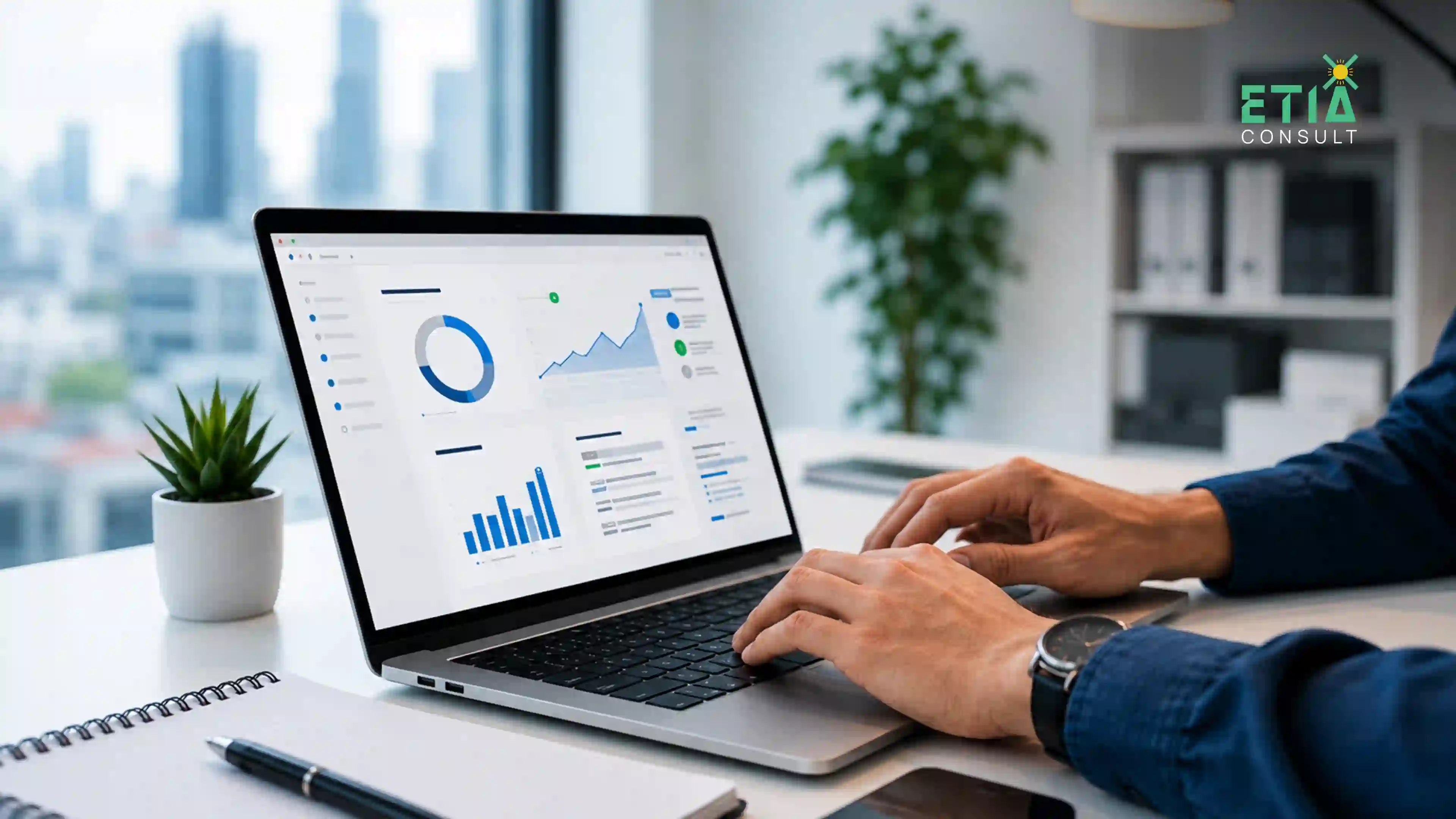
Sustainable innovation should be measurable. Without meaningful indicators, it becomes genuinely difficult to determine whether an initiative is actually delivering value — and without evidence of value, it is equally difficult to build the organisational commitment needed to continue investing in transformation. Measurement is not an afterthought in ETIAconsult’s consulting framework — it is designed alongside the solution, not bolted on after deployment.
The UN PRI’s ESG measurement principles and the GRI Standards both emphasise that organisations performing best on sustainability consistently use measurement frameworks that extend beyond financial returns — capturing environmental, operational, customer, and workforce outcomes alongside commercial metrics. ETIAconsult applies this same multi-dimensional measurement approach to digital transformation initiatives.
Key Measurement Dimensions for Sustainable Digital Transformation
- Operational efficiency — process speed, error rates, automation rates, and the manual effort hours released by digital interventions
- Cost optimisation — direct cost reduction, avoided costs, and the return on digital investment over relevant time horizons
- Customer satisfaction — service quality, response times, and the customer experience improvements that digital enablement delivers
- Employee productivity and digital adoption — actual usage rates and productivity gains, not just training completion
- Resource consumption — energy use, material consumption, and the environmental footprint of both the technology and the processes it enables
- ESG and sustainability outcomes — connecting digital performance to data-driven ESG strategy metrics and CSRD disclosure requirements
Building Capabilities, Not Dependency — H3 with Framework Context
One of the most important aspects of Digital innovation for sustainability is developing internal capability rather than creating dependency on external expertise. Knowledge transfer, training, documentation, leadership involvement, and employee engagement help teams become confident in managing new technologies and processes independently — ensuring that transformation outcomes persist long after the consulting engagement concludes. This approach also prepares organisations to respond to future changes without starting from scratch each time a new technology emerges or a regulatory requirement shifts.
A Balanced Approach to Sustainable Digital Progress
The most successful digital initiatives balance ambition with practicality. Organisations need to be willing to explore new ideas, but they also need to understand costs, risks, capabilities, and long-term consequences before committing. ETIAconsult’s approach to Digital innovation for sustainability can be understood through four integrated lenses — each essential, each reinforcing the others:
Strategy Provides Direction
Clear strategic objectives define which digital investments deserve priority — connecting Innovation guidance to business outcomes rather than technology trends or competitor pressure.
Technology Provides Capability
Selected and implemented thoughtfully, technology creates the operational capability that enables better decisions, faster processes, and more intelligent resource use across the organisation.
People Enable Adoption
Digital enablement and enterprise innovation culture ensure that technology is actually used by the people it is designed to support — making adoption, not installation, the measure of success.
Sustainability Provides Perspective
A robust Responsible business approach provides the longer-term evaluation lens — ensuring that innovation creates enduring value rather than short-term wins that generate hidden costs for the future.
When these four elements work together, Digital innovation for sustainability becomes more than a collection of digital projects. It becomes part of how an organisation learns, improves, and creates value continuously — the operating capability that ETIAconsult’s framework is designed to build. This connects to ETIAconsult’s broader advisory across decarbonization, sustainable energy solutions, and the future-ready business framework that places innovation at the heart of long-term resilience.
Making Innovation Resilient and Future-Ready
The technology landscape changes quickly. Today’s preferred platform may be superseded by a different approach in three to five years. A truly Digital innovation for sustainability framework must therefore be flexible enough to accommodate change — built around enduring organisational capabilities rather than dependencies on specific tools or vendors that may not exist in their current form a decade from now.
Rather than building strategies around individual technologies, the most resilient organisations focus on the underlying capabilities that remain valuable as specific tools and platforms evolve. These enduring capabilities are what ETIAconsult’s consulting framework helps organisations build — and they align directly with the agile consulting approach that keeps organisations adaptive rather than locked into today’s solutions:
Frequently Asked Questions
Key questions on Sustainable business transformation, Innovation guidance, and digital enablement
Ready to Start Your Sustainable
Digital Transformation Journey?
ETIAconsult helps European organisations design and execute Digital sustainability initiatives programmes — connecting Digital innovation advisory, sustainability strategy, digital enablement, and enterprise innovation to create lasting organisational capability and measurable business value.