


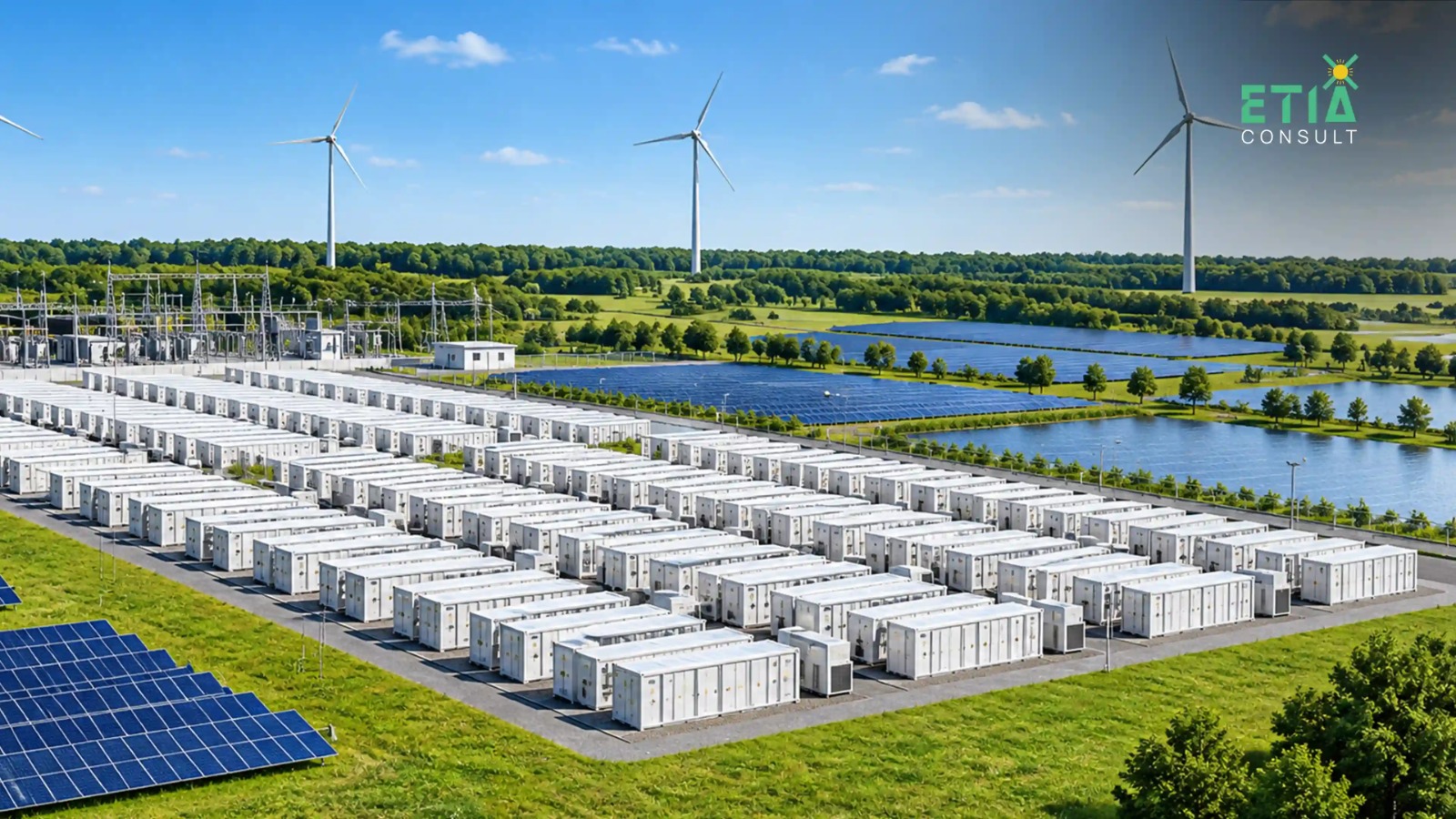

Battery energy storage systems are becoming one of the most consequential technologies in the global energy transition. As renewable generation expands rapidly and electricity demand becomes more dynamic, power systems face growing requirements for flexibility — the ability to store electricity when it is abundant and release it precisely when it is needed. Solar and wind have become central to the energy mix, but their output changes with weather and time of day. This creates the need for battery energy storage systems that can bridge the gap between variable generation and evolving demand patterns — while simultaneously opening new commercial opportunities across grid storage, battery trading, and renewable integration markets.
What Are Battery Energy Storage Systems?
Battery energy storage systems store electrical energy in batteries and release it later when required. A typical BESS installation combines battery modules with power conversion equipment, control systems, monitoring technology, and safety infrastructure — functioning as an integrated platform in which hardware and software work together to manage when the system charges and discharges based on market conditions, grid requirements, and energy availability.
These systems range from relatively small installations supporting individual commercial facilities to large utility-scale projects connected directly to electricity grids — with the largest deployments now reaching multiple gigawatt-hours of capacity. The scale of deployment has expanded dramatically as energy storage technology costs have fallen and as the commercial value of storage has become clearer to both operators and investors. The IEA’s renewables and storage outlook identifies battery energy storage systems as one of the fastest-growing energy technologies globally — with installed capacity expected to multiply several times over before 2030.
How Battery Energy Storage Systems Work — The Core Cycle
Why BESS Matters for Modern Energy Markets
Electricity has traditionally been difficult to store economically at large scale, requiring generation to closely follow demand at all times. Battery energy storage systems change this fundamental constraint by introducing genuine flexibility into power systems that have historically relied on matching supply and demand in near-real time. This shift has profound implications for how electricity markets operate, how renewable energy is valued, and how commercial opportunities are structured.
The strategic importance of BESS extends well beyond the simple ability to store power. Storage changes the timing and flexibility of energy supply — enabling a range of market functions that were previously impossible or economically unattractive. This is why battery energy storage systems are now central to the energy transition trends reshaping global markets and the future-ready energy business strategies ETIAconsult helps organizations develop.
- Managing electricity price fluctuations — storing energy when it is cheap and releasing it when prices are higher, creating commercial value from market volatility
- Supporting grid stability — providing fast frequency response and reserve capacity that keeps power systems operating reliably as conventional synchronous generation declines
- Integrating renewable generation — decoupling renewable output from demand, improving utilisation of solar and wind assets and reducing the curtailment that wastes clean generation
- Reducing curtailment — absorbing excess renewable electricity that would otherwise be wasted when generation exceeds demand or network capacity
- Providing backup capacity — improving energy resilience for commercial and industrial operations that depend on reliable power availability
- Supporting local energy resilience — enabling communities, industrial sites, and commercial facilities to manage their energy supply and demand independently of wholesale market conditions
Battery Energy Storage Systems and Renewable Integration
Renewable integration is one of the strongest commercial and policy drivers behind battery energy storage systems deployment globally. Solar generation often reaches its highest levels during the middle of the day, while electricity demand may remain high into the evening — creating a structural mismatch between when clean energy is produced and when it is most needed. Without sufficient flexibility, excess solar generation may have to be curtailed, wasting clean electricity and reducing the economic return on renewable investment.
A BESS connected to a solar project — or positioned at a strategic grid location — can charge when renewable output is abundant and discharge later when demand rises or renewable generation falls. This solar-plus-storage configuration significantly improves project economics by increasing the hours during which clean generation can be delivered to market, reduces curtailment losses, and enables developers to capture higher evening prices rather than being constrained to midday price periods.
Wind projects benefit from a similar logic, particularly offshore wind where production patterns rarely align precisely with peak demand. As the IEA’s clean energy transition research demonstrates, storage is increasingly the enabling technology that makes high-renewable power systems stable and commercially viable — not a nice-to-have addition to renewable portfolios but a core infrastructure requirement. This renewable integration role connects directly to ETIAconsult’s advisory on sustainable energy strategy and decarbonization pathways for energy organizations.
Storage does not make renewable generation completely predictable — but it gives system operators, network companies, and renewable developers another essential tool for managing variability. Battery energy storage systems are not a substitute for grid infrastructure or generation diversity, but they are an increasingly indispensable complement to both.
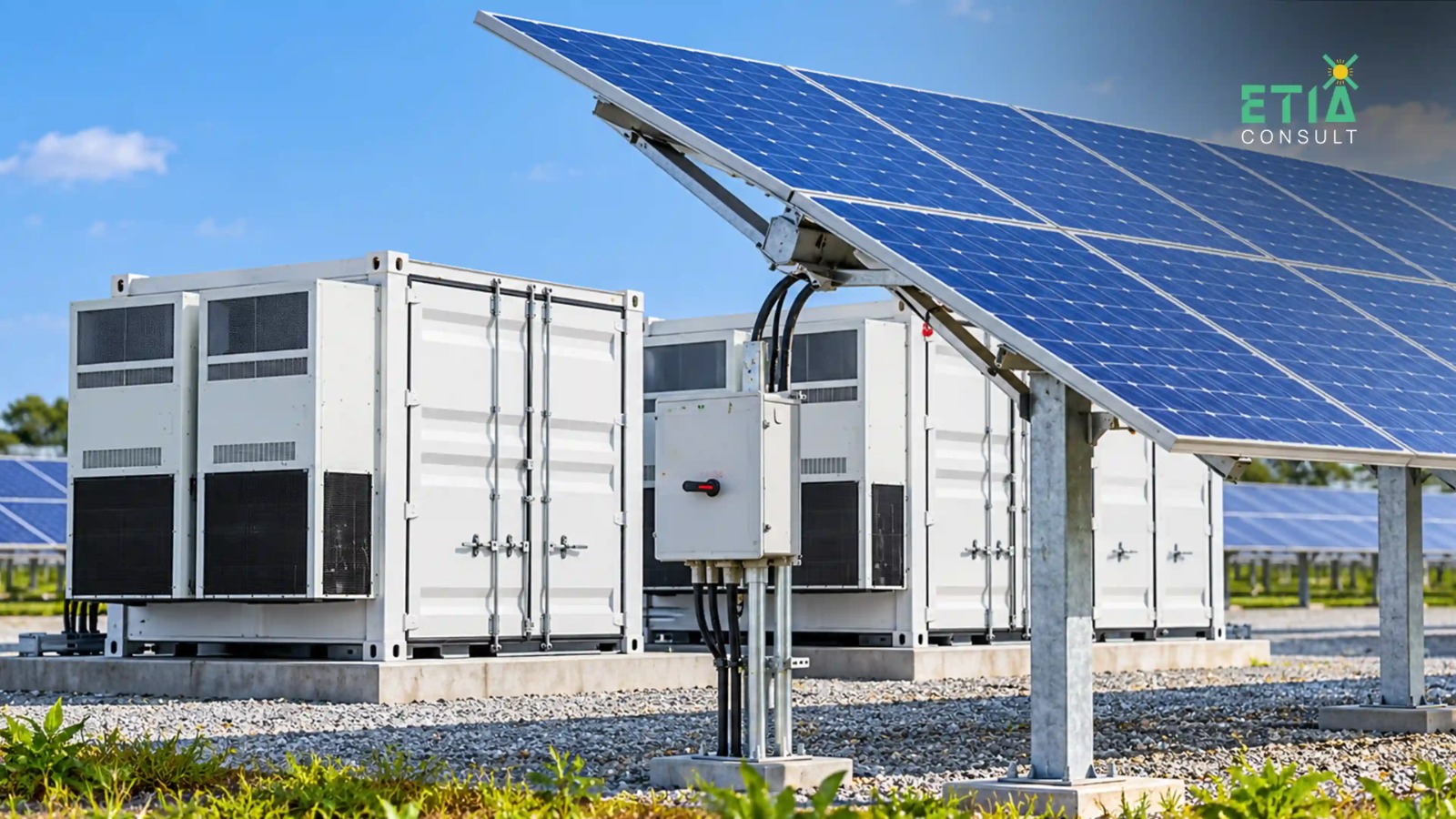
The Growing Role of Grid Storage in Power System Operations
Grid storage refers to battery energy storage systems connected to or supporting electricity networks — providing services that help maintain a reliable, responsive, and efficient power system. Large-scale BESS installations can deliver a range of ancillary services that were previously provided almost exclusively by conventional thermal generation — and in many cases, they can provide these services faster, more precisely, and at lower marginal cost.
The speed advantage is particularly important for grid balancing applications. Battery energy storage systems can respond to changes in system frequency within milliseconds — significantly faster than conventional generation assets that require minutes to ramp up or down. This makes BESS highly valuable for primary frequency response services that prevent small frequency deviations from escalating into larger system disturbances. According to ENISA’s critical infrastructure research, the resilience of electricity networks is increasingly linked to the availability of fast-response flexibility resources — of which BESS is the most scalable current option.
Frequency Regulation
Millisecond-speed response to grid frequency deviations — maintaining the 50Hz balance that keeps European power systems stable. BESS can provide Primary Frequency Response (PFR) and Dynamic Containment (DC) services that grid operators increasingly value as synchronous generation declines.
Reserve Capacity
Providing standing reserve and response capacity that grid operators call upon when generation shortfalls or demand spikes threaten system stability — complementing the declining availability of conventional thermal reserve as coal and gas plants retire across European power markets.
Congestion Management
Strategically located grid storage can reduce network congestion by absorbing generation that would otherwise overload transmission or distribution assets — potentially deferring costly grid infrastructure upgrades or avoiding renewable curtailment caused by network constraints.
Balancing Supply and Demand
Participating in short-term electricity balancing markets — providing TSOs and DSOs with the controllable, fast-responding resource needed to manage the second-to-second and minute-to-minute imbalances that grow as renewable penetration increases.
Grid storage can also support areas where electricity infrastructure is under pressure. In some situations, strategically located storage can help manage local constraints without relying exclusively on conventional infrastructure upgrades — a network deferral benefit that is increasingly recognised by regulators and used in distribution network planning. This is connected to the broader data analytics and energy market intelligence that ETIAconsult uses to identify storage value opportunities for its clients.
Energy Storage Technology Is Becoming More Advanced
Energy storage technology continues to develop at a rapid pace, with improvements in energy density, efficiency, safety, control software, and system design making battery energy storage systems more capable and economically attractive with each successive generation. Lithium-ion chemistry currently dominates stationary storage at commercial and utility scale, while alternative chemistries — including sodium-ion, iron-air, flow batteries, and solid-state technologies — are being developed for applications where different characteristics may be more valuable.
The technology is not simply about the battery cells themselves. A modern BESS is an integrated platform in which sophisticated hardware and software work together — making the energy management system (EMS) layer increasingly as important as the battery chemistry in determining how much value a storage asset can capture from available market opportunities. Advances are occurring across multiple dimensions simultaneously:
The Emergence of Battery Trading as a Commercial Strategy
As battery energy storage systems become more integrated into electricity markets, battery trading is creating significant new commercial possibilities for storage asset owners and operators. A BESS can potentially participate in several markets or provide multiple services simultaneously or sequentially during its operating life — making it a flexible market asset rather than simply a unit of stored electricity.
This multi-revenue or “stacking” approach is what distinguishes sophisticated battery trading strategies from simple energy arbitrage. The challenge is intelligently allocating the battery’s limited capacity — state of charge, cycle count, power capacity — among competing opportunities in a way that maximises total value over time while respecting technical constraints and avoiding premature degradation. This connects directly to the ETRM system capabilities and energy market analytics that sophisticated BESS operators use to manage and optimise their asset portfolios.
Battery Trading Revenue Streams — Revenue Stacking
Energy Arbitrage
Charging when electricity prices are low — often during periods of high renewable generation — and discharging when prices are higher, capturing the price spread as revenue. Successful arbitrage requires sophisticated price forecasting and optimisation rather than simply reacting to the cheapest and most expensive hours in isolation.
Ancillary Services
Providing frequency response, reserve, reactive power, and other system services to transmission system operators — typically contracted services that generate predictable income streams and are often prioritised over energy arbitrage in the revenue stack due to their capacity payment structure.
Capacity Mechanisms
Participating in capacity market auctions — providing committed availability to grid operators in exchange for capacity payments that provide revenue certainty. European capacity markets are evolving to accommodate BESS as an alternative to thermal peaking plant capacity.
Renewable Energy Optimisation
Co-located storage that captures renewable output that would otherwise be curtailed and shifts it to higher-value periods — improving the return on renewable generation assets and reducing the “capture rate discount” that solar and wind developers face as market penetration increases.
The challenge in battery trading is allocating the battery’s limited cycle capacity among competing opportunities. If a BESS is committed to a frequency response service, it may have limited capacity for arbitrage in the same period. Effective battery trading therefore requires continuous optimisation — understanding not only what the battery can do, but when preserving its capacity for one opportunity may be more valuable than using it for another. This is precisely the type of commercial intelligence that AI in energy trading is increasingly being applied to support.
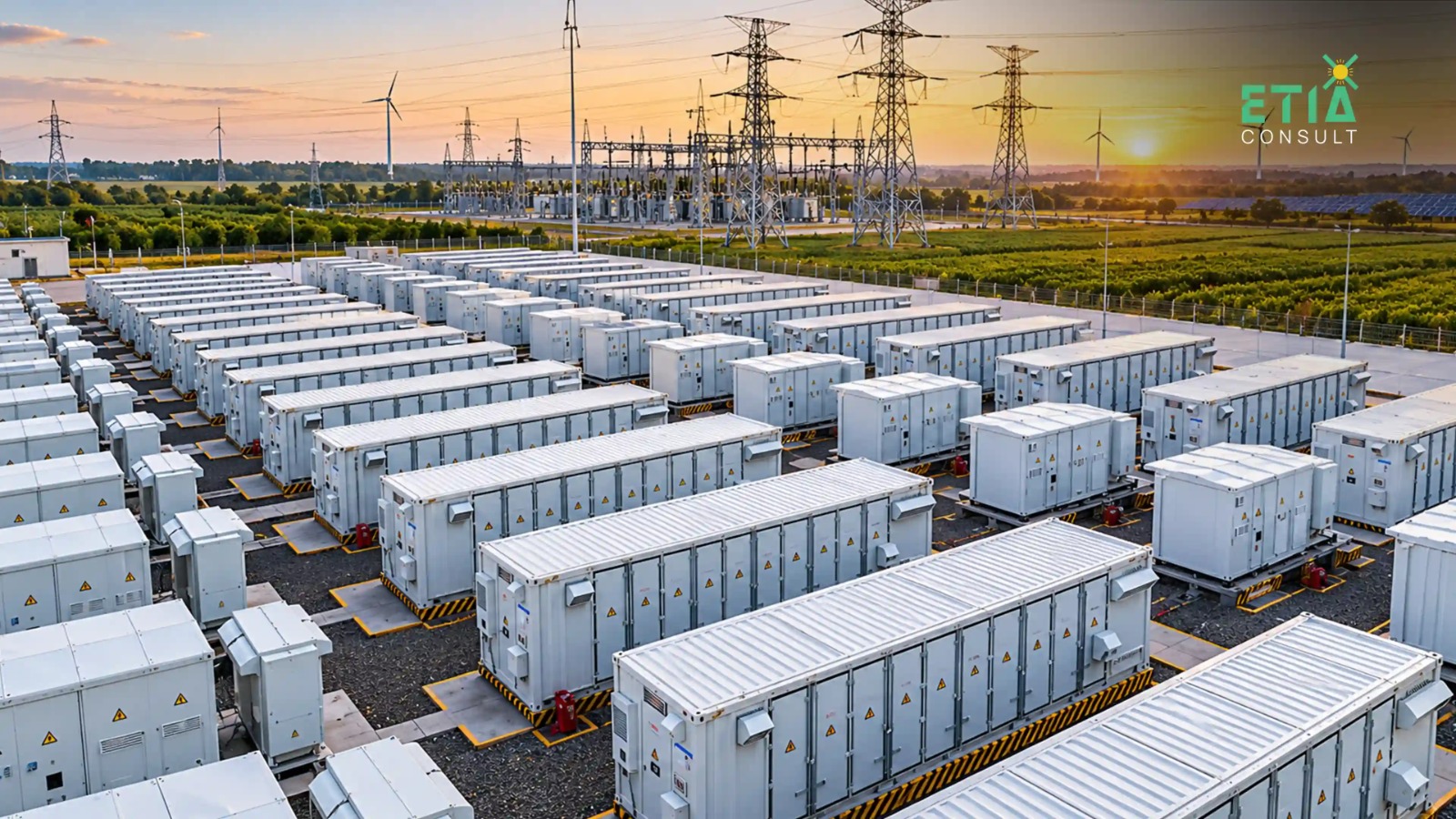
Reducing Renewable Curtailment and Improving Energy Resilience
Renewable curtailment occurs when available renewable electricity cannot be fully used or delivered — either because generation exceeds demand at that moment, or because network constraints prevent electricity from reaching where it is needed. As renewable penetration increases across European power systems, curtailment is becoming an increasingly significant economic and efficiency problem. Battery energy storage systems can absorb this excess electricity and release it later — turning electricity that would otherwise have been wasted into a usable and commercially valuable resource.
This curtailment reduction benefit is particularly important as more countries approach the generation levels where curtailment becomes structurally significant. The EU ETS carbon pricing framework makes every unit of clean electricity that is curtailed represent a real economic cost — not just wasted energy but a missed opportunity to displace carbon-emitting generation. BESS that captures this curtailed electricity and shifts it to periods where it displaces fossil generation creates double value: economic and environmental.
Beyond Wholesale Markets — Commercial and Industrial Energy Resilience
Battery energy storage systems are also becoming relevant beyond wholesale electricity markets. Commercial buildings, industrial facilities, campuses, data centres, and other energy-intensive sites can use BESS to manage peak demand charges, shift consumption to more favourable tariff periods, support critical operations during grid outages, and work alongside on-site solar generation — improving energy storage technology returns from distributed renewable assets while reducing exposure to retail electricity cost volatility.
Peak Demand Management
Reducing electricity demand during peak tariff periods — discharging stored energy during the demand measurement windows that determine network charges, potentially reducing capacity charges by 20–40% depending on site profile and tariff structure.
Solar Self-Consumption Optimisation
Storing surplus solar generation during midday periods and using it during morning and evening periods — increasing the proportion of on-site solar that is consumed rather than exported at low feed-in tariff rates, improving solar project economics for commercial and industrial sites.
Backup and Resilience Capacity
Maintaining critical operations during grid outages — increasingly important for industrial facilities, hospitals, data centres, and commercial operations where grid interruption causes disproportionate cost or safety risk, and where BESS provides a cleaner and faster alternative to diesel backup generation.
Demand Response Participation
Using stored energy to participate in demand response programmes — providing flexibility services to utilities and aggregators while benefiting from incentive payments that improve the overall return on the BESS investment across combined grid-side and behind-the-meter revenue streams.
The Critical Importance of Intelligent BESS Management
Installing a battery energy storage system is only the beginning. How the system is operated has a major influence on the value it captures over its lifetime. Energy management software that analyses market conditions, renewable forecasts, electricity demand patterns, grid signals, and battery state continuously — adapting dispatch decisions in real time — can significantly outperform systems operated on fixed schedules or simple price thresholds.
This intelligent management layer becomes especially critical when a BESS participates in multiple markets simultaneously. The system must understand not only what the battery can technically do, but when preserving its capacity for future opportunities may be more valuable than using it immediately. This optimisation challenge is driving increasing adoption of machine learning and AI-driven dispatch tools — connecting to ETIAconsult’s advisory on AI in energy trading and storage optimisation and the data analytics capabilities that enable better storage dispatch decisions.
Honest Limitations — What BESS Cannot Do
Despite their advantages, battery energy storage systems are not a universal answer to every energy challenge. Storage projects must navigate capital costs, operating conditions, cycle degradation, safety requirements, land constraints, grid connection availability, market regulations, and project economics that vary significantly by location and application. Battery duration is a particularly important design consideration — most current BESS installations are optimised for two-to-four hour discharge durations, making them highly effective for intraday arbitrage and ancillary services but less suited to providing multi-day energy backup or seasonal storage. Longer-duration storage applications require either larger BESS installations or alternative technologies such as pumped hydro, compressed air, or emerging long-duration battery chemistries.
This is why battery energy storage systems are most accurately understood as one important component within a broader, diverse energy system — complementing renewable generation, conventional capacity, demand response, and grid infrastructure rather than replacing any of them individually. The energy transition strategy that ETIAconsult helps organizations develop always considers storage within this broader system context.
What the Future of Battery Energy Storage Systems Could Look Like
As renewable generation expands and electricity demand evolves — with electrification of transport, heat, and industry dramatically changing load profiles across European power systems — flexibility will become progressively more valuable. Battery energy storage systems could become an important structural layer connecting generation, markets, networks, and consumers in ways that today’s power systems are only beginning to explore.
The energy market of the future is unlikely to rely on a single storage technology. Different generation, storage, transmission, and demand-side resources will need to work together within a coordinated system — making the integration and optimisation expertise that ETIAconsult brings to energy technology integration increasingly valuable as storage becomes central to energy system architecture.
Frequently Asked Questions
Key questions about battery energy storage systems, BESS, grid storage, and battery trading
Ready to Explore Battery Energy
Storage Systems for Your Organisation?
ETIAconsult helps European energy organisations evaluate, design, and optimise battery energy storage systems — from BESS project assessment and grid storage strategy to battery trading market participation and intelligent energy management frameworks.